
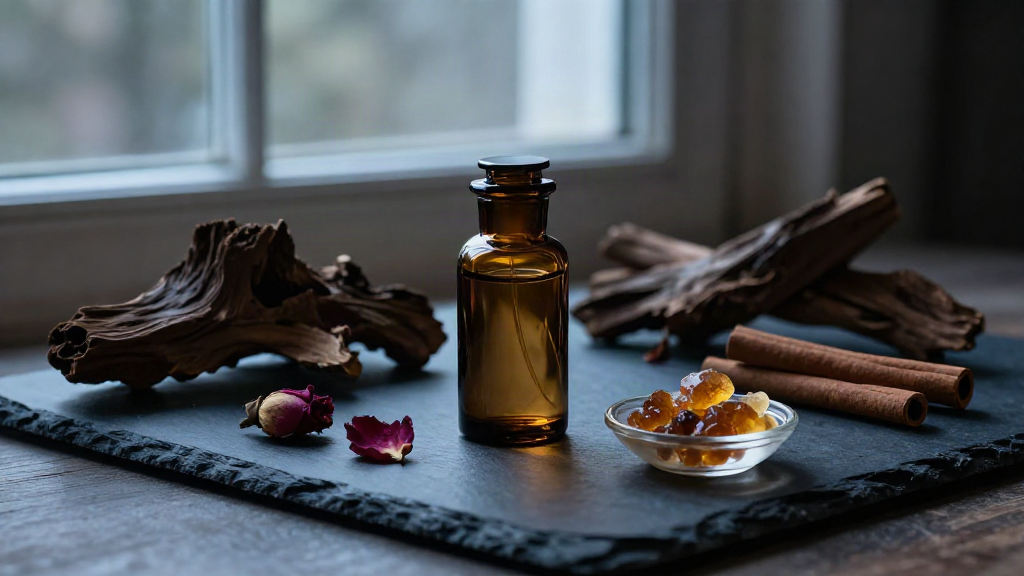
Oud is not a summer material, and it rarely behaves like one. As the temperature drops, the skin runs cooler, the air holds less moisture, and the way a fragrance unfolds across the day changes with it. That shift is the whole reason oud, amber and resin-heavy compositions come into their own between October and February. This guide explains why these notes perform better in cold air, then walks through a shortlist of the best oud fragrances for winter – smoky, sweet and resinous picks – and how to choose between an evening statement and an everyday cold-weather wear.
Why oud and amber wear differently in cold air
A fragrance is a set of molecules with different evaporation rates. The light, volatile top notes – citrus, aromatics, aldehydes – burn off fastest, and they tend to burn off even more quickly on warm skin. In winter, cooler skin slows that opening phase, so the composition arrives in stages rather than in a rush. The heart and, more importantly, the base have more room to develop.
That matters for oud because oud almost always sits in the base, next to amber, resins, woods, tobacco and vanilla. These are the heaviest molecules in the formula, and they linger longest by design. In cold, dry air they release more slowly, which means less of the sharp, medicinal edge raw oud can carry and more of the round, resinous warmth underneath it. Amber and benzoin behave the same way – syrupy and sweet in summer, dense and enveloping in winter.
There is a practical side too. Cold air and indoor heating both dry the skin, and dry skin holds scent molecules poorly. This is the season where a high concentration earns its keep: an Extrait de Parfum, with its higher proportion of perfume oil, has more material available to anchor to the skin across a long, cold day. If you want to understand the difference between concentrations, the short version is that extrait is the most concentrated form most houses offer – which is exactly why it suits a deep oud.
The shortlist: smoky, sweet and resinous oud picks for winter
The right winter oud depends less on how loud it is and more on the mood you want to carry. Here are the directions worth knowing, each with a scent profile that explains the wear.
Smoky and dark – for cold evenings
If you want oud at its most atmospheric, look for tobacco, incense and woods sitting alongside it. Tobacco Oud pairs warm spices, smoky incense and precious woods with rich tobacco, Madagascar vanilla and amber. It is unapologetically dark and best suited to evening wear or the coldest days, when its smoke reads as comfort rather than weight. Black Tea Tabac, our interpretation of the smoky, aromatic The Noir 29 profile, takes a more restrained route: dark and woody, but light enough to wear to work once the weather turns.
Resinous and sweet – for warmth without smoke
Not everyone wants smoke. The gourmand-leaning end of oud trades incense for sweetness and still holds up in the cold. Tonka Oud combines saffron and bergamot with deep oud, Bulgarian rose, sweet tonka bean, sugar cane and warm amber – a powerful but rounded composition where the tonka and sugar soften the oud’s darker edges. Oud Bouquet leans further into indulgence, bringing deep oud together with velvety rose, praline, creamy vanilla and smoky guaiac wood for an opulent, gourmand warmth.
Rosy and opulent – for a richer signature
Rose and oud is one of perfumery’s oldest pairings, and it reads beautifully in winter. Arabian Rose builds opulent Damask rose over earthy patchouli, rich oud, amber and vanilla, while Satin Oud sets Bulgarian and Turkish roses against deep oud, delicate violet and a base of vanilla, amber and benzoin. Both are dense, smooth and long-wearing – the kind of composition that suits a signature rather than a rotation.
Fruity and unexpected -for contrast
If a pure oud feels too heavy, a fruit note can lighten the base without dismantling it. Mango Oud sets juicy tropical mango against oud, leather and dry woods, and Passion of Oud pairs vibrant passionfruit with powerful oud, saffron, Turkish rose and dark leather. Fruity, yes – but the oud keeps them grounded when the temperature falls.
Choosing between an evening oud and an everyday winter wear
The simplest way to avoid buying a bottle you never reach for is to decide, honestly, when you will wear it. Ask three questions.
First, how far do you want it to project? A tobacco-oud or rose-oud extrait with high projection and heavy sillage is designed to announce itself, which is ideal for evenings and occasions but can be a lot for a shared office. If you want something you can wear daily, favour the resinous-sweet or fruit-forward profiles, which sit closer to the skin.
Second, how sweet do you want the drydown? Winter skin magnifies sweetness, because the heavy base notes dominate for hours. If you already find gourmands cloying, a drier, woody composition will age better across a long day. If you want warmth as a comfort, the tonka, praline and vanilla directions are exactly the point.
Third, what is the base? Oud on its own is a raw material; it is the supporting notes that decide whether the fragrance leans smoky, rosy, sweet or fresh. Read the base before the marketing. It tells you what you will actually smell four hours in.
A practical arrangement is to treat the seasonal shortlist as two tiers: one expressive evening oud for the shortest, coldest days, and one more wearable, resinous or fruity oud for everyday. That way the cold-weather rotation covers both the version of you going out and the version of you on the 7am train.
A note on how these are made
Every composition above is compounded as an Extrait de Parfum in our Brighton lab – vegan, cruelty-free and paraben-free – so the concentration matches the heavy, base-led scent profiles winter calls for. They are independent Formula Fragrances interpretations of well-known scent profiles, not affiliated with, endorsed by or produced by the referenced brands; the referenced names describe the profile being interpreted, not the product you receive.
The short answer
The best oud fragrance for winter is the one whose base you actually enjoy for six or seven hours, not the one with the biggest reputation. If you want smoke, go tobacco and incense. If you want warmth without smoke, follow the tonka, rose and amber directions. If you want something you can wear every day, keep the projection moderate and the fruit lighter. Choose the composition first, and the bottle follows – that is the whole point of reading what is inside it.
Explore the full Formula Fragrances oud collection to compare compositions side by side, or design and personalise your own bespoke blend if none of the shortlist matches the mood you are after.