
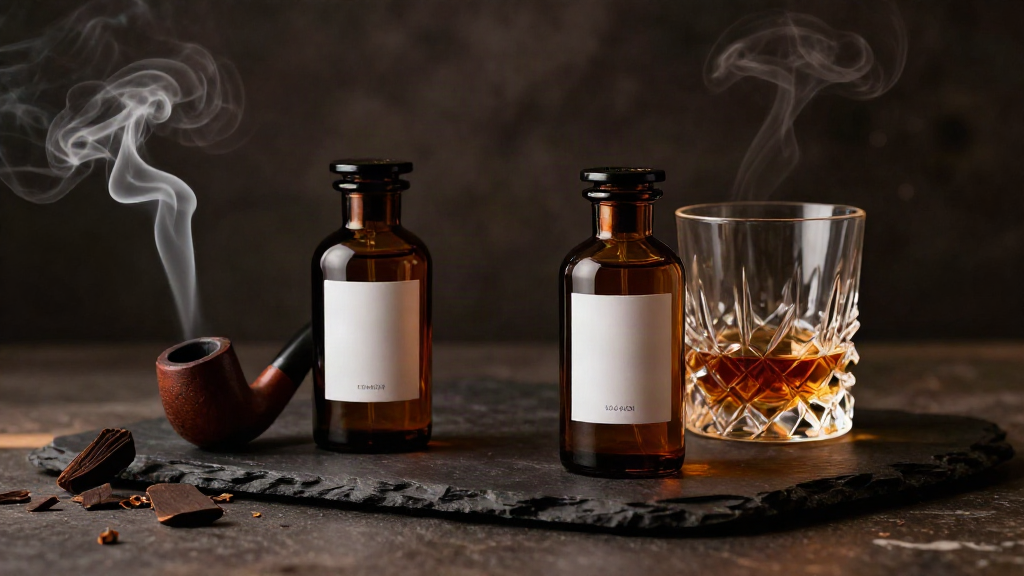
If you have decided that your next fragrance should be dark, warm and unapologetically evening-wear, you have probably narrowed things down to a smoky profile. Within that world, a tobacco oud perfume sits at one end of the spectrum and a rum-and-vanilla tobacco at the other. Tobacco Oud and Club Jazz are our two most direct answers to the smoky-evening brief, and they are not interchangeable. Here is an honest, side-by-side read on what separates them, so you can choose on notes and behaviour rather than marketing names.
What actually makes a scent read as “smoky”
Smoke in perfumery is not one material but a family of effects. Incense and frankincense resins give a dry, spiritual, almost ash-like haze; guaiac wood and birch bring a tarry, leathery char; tobacco leaf adds sweet, cured warmth; and woods such as oud and patchouli supply the dense, resinous base that holds it all in place. Two fragrances can both smell unmistakably “smoky” and share almost no overlap in how sweet, dry or loud they are. That is exactly the distinction between Tobacco Oud and Club Jazz.
Tobacco Oud: spice, incense and dry woods
Tobacco Oud is the drier, more austere of the two. It opens with warm spice before settling into a heart of smoky incense and rich tobacco leaf, then resolves into a base of precious woods, Madagascar vanilla and amber. The sweetness is present but restrained – the vanilla is there to soften the edges of the smoke, not to lead with it. The overall impression is dark, intense and deliberately bold: think resinous oud, dry incense and cured tobacco rather than dessert.
Because so much of its weight comes from woods and resins, Tobacco Oud projects with a certain gravity. It is the sort of composition that announces itself in a quiet room and stays composed through a long evening. If you already know you love oud, incense and dry woody bases, this is the profile that will feel familiar and correct.
Club Jazz: rum, vanilla and lounge warmth
Club Jazz takes the same starting point – smoky tobacco – and steers it somewhere sweeter and more relaxed. Modelled on the late-night lounge idea, it blends warm rum and smooth tobacco with a generous pour of vanilla, so the smoke arrives wrapped in boozy sweetness rather than dry resin. Where Tobacco Oud is austere, Club Jazz is enveloping and conversational.
The vanilla here is more prominent and the overall texture smoother and rounder. That makes Club Jazz genuinely easier to wear in mixed company and closer to what many people picture when they imagine a comforting winter fragrance. It is still an evening scent, but a sociable one rather than a formal one.
Head to head: warmth, sweetness and projection
Set side by side, the two diverge on three axes that matter most when you are buying blind.
Warmth and dryness. Tobacco Oud leans dry and resinous, driven by incense and woods. Club Jazz leans sweet and smooth, driven by rum and vanilla. If “dry and smoky” appeals more than “sweet and smoky”, Tobacco Oud is your pick.
Sweetness. Club Jazz is clearly the sweeter of the pair. Tobacco Oud’s vanilla is a supporting note; Club Jazz’s vanilla is a lead note. Choose accordingly if you dislike gourmand-leaning tobacco.
Intensity and longevity. Both are compounded as Extrait de Parfum, so both are concentrated and long-lasting by design. Tobacco Oud reads a touch more intense and formal because of its resinous woods; Club Jazz reads a touch more approachable. Neither is a light, fleeting scent – a little goes a long way with either.
Choosing by occasion and season
The occasion test usually settles the decision faster than the note list.
Reach for Tobacco Oud for formal evenings, cooler weather and moments when you want presence: a long dinner, a winter event, an evening where you would rather be remembered than blend in. Its dry, incense-led character suits tailoring and low light.
Reach for Club Jazz for nights out, relaxed dinners and gatherings where you want warmth rather than authority. Its boozy sweetness and gentle projection make it the friendlier of the two, and it layers comfortably into a cosy, autumnal wardrobe.
Seasonally, both belong to the colder half of the year. In high summer they can feel heavy, so they earn their keep from autumn through to early spring.
Why formulation matters more than the label
Both scents are independent interpretations, not affiliated with any referenced designer house, and both are compounded as Extrait de Parfum in our Brighton lab. That concentration matters: a higher perfume-oil load is what gives a smoky composition its depth and its staying power, and it is the reason these two punch above what you might expect at this price. They are also vegan, cruelty-free and paraben-free – the anti-hype position is simply that you should be able to read exactly what is in the bottle and how strongly it is built, rather than pay for a name.
Judged that way, the choice is refreshingly technical. You are not choosing between a “good” and a “lesser” fragrance; you are choosing between two structures: dry, resinous and formal, or sweet, boozy and easygoing.
How to decide
If the words you reach for are incense, woods and dry tobacco, choose Tobacco Oud. If they are rum, vanilla and warmth, choose Club Jazz. If you are genuinely torn, start with the profile that matches your current evening rotation: a drier scent if you already favour woody ouds and incense, a sweeter one if you gravitate towards gourmand and amber tobaccos. Either way, you are buying a formulation-first extrait built for cool-weather evenings – and, if you want both a formal and a sociable option, they sit far enough apart to justify having each on the shelf.